
This is true! In California state authorities impose special Halloween restrictions on registered sex offenders and parolees.
The California Department of Corrections and Rehabilitation is the agency charged with supervising sex offender parolees. Since 1994, the department has run a statewide Halloween night event called “Operation Boo,” in which law enforcement conduct compliance checks on known sex offenders. Under Operation Boo, registered sex offenders who are on parole or probation must follow these rules between 5 p.m. and 5 a.m. on Halloween night:
- Stay in their own home
- Not answer the door for anyone except law enforcement
- Keep all exterior lights off
- Cannot pass out treats
- Cannot decorate their house for Halloween
- Until 2016 in some counties, post a sign in a visible location outside of the home that discourages trick-or-treaters
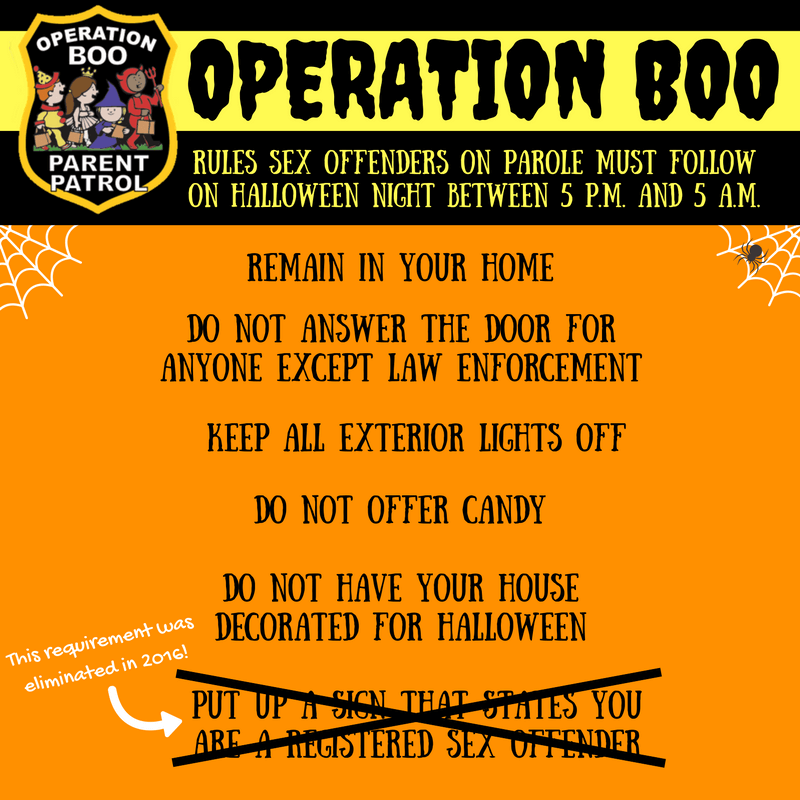
Image Source: wksexcrimes.com
An organization called California Reform Sex Offender Laws filed a lawsuit in federal court to have the sign requirement declared unconstitutional. The lawsuit claims that claims that the sign requirement violates the First Amendment and puts registered sex offenders on parole, and those who live with them, in danger. The lawsuit also contended that authorities enforce the Halloween policy in an “arbitrary and unreasonable manner,” taking no account of the age of a sex offender’s conviction or whether it even involved a crime against a child.
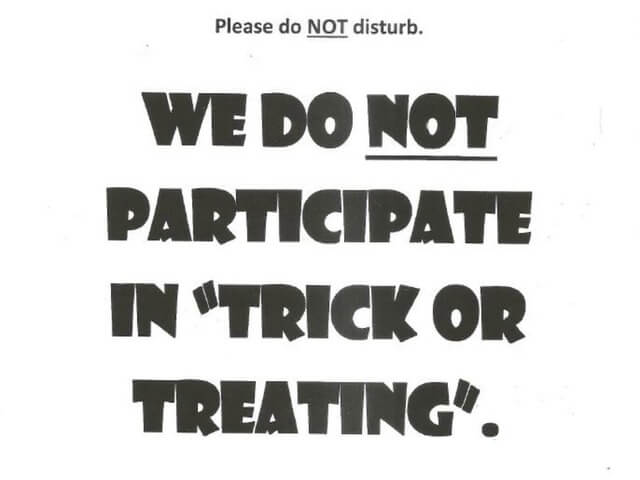
Image Source: 10news.com
In 2016, a federal court agreed that the sign requirement was unconstitutional, and issued a temporary restraining order against the CDCR to stop enforcing it. The CDCR settled and agreed to drop the sign requirement from Operation Boo. However, the other rules of Operation Boo remain in place, such as the prohibition against decorating and passing out treats on Halloween night.
What Happens When Sex Offenders Violate California’s Halloween Restrictions?
What are the actual penalties if a registered sex offender violates Operation Boo restrictions in California? California law treats violations of these Halloween parole conditions as parole violations under California Penal Code Section 3000 et seq., subjecting offenders to immediate arrest and potential return to state prison rather than mere citations or warnings.
California Department of Corrections and Rehabilitation data reveals Operation Boo compliance checks resulted in 35 arrests statewide during Halloween 2025, with offenders arrested for violations including not being home by the 5 p.m. curfew, having exterior lights on, possessing Halloween decorations, or allowing family members to answer the door with candy. Parole violation consequences in California include formal revocation hearings before the Board of Parole Hearings, where offenders face potential re-imprisonment for the remainder of their original sentence plus additional custody time for the violation itself.
Here’s what makes these violations particularly serious under California law: even technical violations like arriving home at 5:15 p.m. instead of 5 p.m. trigger arrest and booking into county jail, as documented in recent arrest reports. California courts have upheld these strict enforcement practices under the rationale that parolee liberty remains conditional upon full compliance with all parole terms. The practical reality: approximately 6 percent of supervised sex offenders failed compliance checks during recent Operation Boo sweeps, resulting in parole revocation proceedings that can add months or years to their supervised custody regardless of whether any actual contact with children occurred.
What do you think? Should all registered sex offenders be subject to Operation Boo, or only those with more recent registrations involving children? Do you believe children are at risk from registered sex offenders during trick-or-treating?











This is interesting. I’ve never heard of this and I’m surprised it’s not prevalent in more areas. Halloween and sex offenders seem to be trouble waiting to happen, but it’s just an idea that’s never brought up. We are warned more about tainted candy and to watch for traffic on dark streets. In my area, we have closed in Trick or Treating in “safe” areas, so it’s just not a thought. Do I think that children are more at risk on Halloween? Maybe if unsupervised. I believe in at least a minimal supervision of children no matter the occasion or place.
It’s absurd to put all sex offenders in the same category. A frat guy who runs down the street naked is not the same as a serial child molester, yet both are 290’s. Seems unreasonable!